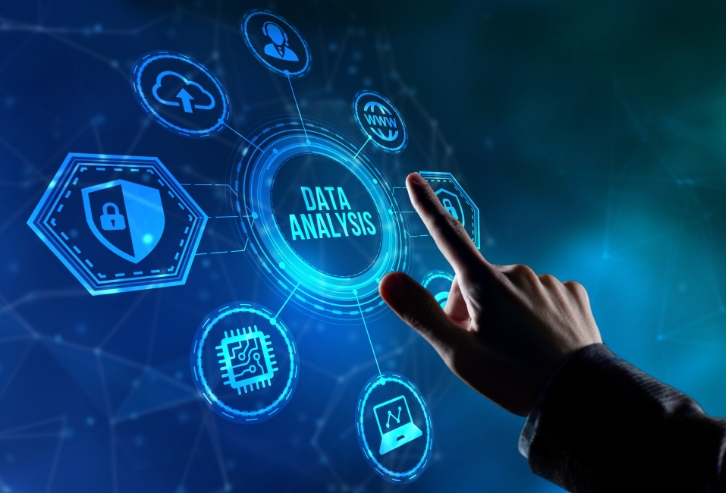
Data Analytics in Business & Industry: Transforming Customer Insights, Forecasting, Marketing, and Operations
In today's hyper-competitive marketplace, organizations that harness the power of data analytics in business gain an undeniable advantage over their rivals. From understanding customer behavior to optimizing supply chains, data-driven decision making has become the cornerstone of modern business strategy. Companies leveraging big data analytics report 23% higher customer acquisition rates and 19% above-average profitability, according to McKinsey research.
This comprehensive guide explores how predictive analytics, business intelligence tools, and AI in business analytics are revolutionizing four critical business domains: customer insights, financial forecasting, marketing performance, and operational efficiency.
Customer Behavior & Retention: Understanding Your Most Valuable Asset
Understanding customer behavior is no longer optional—it's essential for survival. Modern analytics platforms enable businesses to decode complex customer patterns and predict future actions with remarkable accuracy.
Customer Churn Analysis: Identifying At-Risk Customers
Customer churn analysis uses historical data and machine learning algorithms to identify customers likely to discontinue services. By analyzing purchase frequency, engagement metrics, support ticket history, and behavioral signals, businesses can intervene before customers leave.
Netflix exemplifies excellence in churn prevention. The streaming giant analyzes viewing patterns, pause behaviors, and content preferences to predict subscriber cancellations. Their proactive retention strategies, including personalized content recommendations and targeted re-engagement campaigns, have helped maintain industry-leading retention rates exceeding 93%.
Customer Segmentation Strategies: Targeting with Precision
Effective customer segmentation strategies divide your audience into distinct groups based on demographics, purchasing behavior, preferences, and lifetime value. This granular understanding enables personalized marketing, customized product offerings, and optimized resource allocation.
Advanced segmentation leverages clustering algorithms and predictive analytics to identify micro-segments that traditional methods miss. Retailers like Target and Amazon use sophisticated segmentation to deliver hyper-personalized experiences that drive loyalty and increase average order values.
AI-Powered Product Recommendation Engines
AI in business analytics has transformed product recommendations from simple "customers also bought" suggestions into sophisticated prediction systems. These engines analyze browsing history, purchase patterns, demographic data, and real-time behavior to suggest relevant products.
Amazon's recommendation engine generates approximately 35% of the company's total revenue. Spotify's Discover Weekly playlist, powered by collaborative filtering and natural language processing, has become a defining feature that keeps users engaged and reduces churn.
Predictive Analytics in Customer Retention
Predictive analytics enables proactive retention strategies by forecasting customer behavior before it occurs. Machine learning models identify early warning signs of disengagement, allowing businesses to deploy targeted interventions.
Telecommunications companies like T-Mobile use predictive models to identify customers likely to switch carriers. By offering personalized retention offers at optimal moments, they've significantly reduced churn rates while minimizing unnecessary discount expenditures.
Sales & Financial Forecasting: Predicting Tomorrow's Revenue Today
Accurate forecasting transforms business planning from guesswork into science. Modern sales forecasting models combine historical data, market indicators, and AI algorithms to deliver unprecedented accuracy.
Sales Forecasting Models: Beyond Traditional Methods
Contemporary sales forecasting models incorporate multiple data sources, including CRM data, economic indicators, seasonal trends, and competitive intelligence. Machine learning algorithms continuously refine predictions based on actual outcomes, improving accuracy over time.
Salesforce Einstein Analytics exemplifies modern forecasting capabilities, using AI to analyze pipeline data, historical win rates, and sales rep performance to generate highly accurate revenue predictions.
Revenue Prediction Using Historical Data
Historical data analysis forms the foundation of reliable revenue prediction. Time-series analysis identifies patterns, seasonality, and trends that inform future projections. Advanced techniques, including ARIMA models and neural networks, capture complex relationships that simpler methods miss.
Financial Data Analytics and Risk Management
Financial data analytics extends beyond revenue forecasting to encompass risk assessment, fraud detection, and compliance monitoring. Banks and financial institutions use big data analytics to evaluate credit risk, detect anomalous transactions, and ensure regulatory compliance.
JPMorgan Chase's COiN platform analyzes legal documents in seconds—work that previously required 360,000 hours of human labor annually. This demonstrates how data analytics transforms financial operations.
Business Intelligence Tools for Forecasting
Leading business intelligence tools like Tableau, Power BI, and Looker democratize forecasting capabilities. These platforms enable non-technical users to build sophisticated forecasting models, visualize trends, and share insights across organizations.
Marketing Analytics: Maximizing Every Marketing Dollar
Marketing analytics has evolved from basic reporting to sophisticated attribution modeling and predictive optimization. Today's marketers leverage data to understand campaign performance, optimize spend allocation, and predict customer responses.
Social Media Sentiment Analysis
Social media sentiment analysis uses natural language processing to gauge public opinion about brands, products, and campaigns. Real-time sentiment monitoring enables rapid response to emerging crises or opportunities.
Coca-Cola's social listening program monitors millions of conversations daily, enabling the brand to identify trending topics, measure campaign impact, and respond to customer concerns before they escalate.
Website Traffic Analysis and Conversion Tracking
Understanding website behavior is crucial for digital success. Advanced analytics platforms track user journeys, identify conversion bottlenecks, and optimize user experiences. Heat mapping, session recording, and funnel analysis reveal opportunities for improvement.
Digital Marketing ROI Measurement
Measuring digital marketing ROI requires sophisticated attribution models that account for multiple touchpoints across extended customer journeys. Marketing analytics platforms integrate data from paid media, email campaigns, social channels, and website interactions to calculate true campaign effectiveness.
Google Analytics 4 represents the evolution of measurement capabilities, using machine learning to fill data gaps created by privacy regulations while providing predictive metrics like purchase probability.
Performance Marketing Analytics
Performance marketing analytics focuses on optimizing paid advertising campaigns for maximum efficiency. Real-time bid optimization, audience targeting refinement, and creative testing drive continuous improvement in advertising ROI.
Operational Optimization: Streamlining Business Processes
Operational excellence increasingly depends on analytics-driven optimization. From supply chains to workforce management, data transforms how businesses operate.
Supply Chain Analytics: Building Resilient Operations
Supply chain analytics provides visibility across complex global networks. Predictive models anticipate disruptions, optimize routing, and balance inventory across distribution networks.
Walmart's supply chain analytics capabilities enable same-day inventory visibility across 11,000 stores worldwide. During the pandemic, these capabilities allowed rapid adaptation to unprecedented demand shifts.
Inventory Optimization Software
Modern inventory optimization software balances carrying costs against stockout risks using demand forecasting, lead time analysis, and service level requirements. Machine learning models continuously refine reorder points and safety stock calculations.
Workforce Analytics and Employee Performance Analysis
Workforce analytics provides insights into employee productivity, engagement, and retention. Performance analysis identifies top performers, predicts turnover, and optimizes scheduling.
Google's Project Oxygen used workforce analytics to identify management behaviors that drive team performance, fundamentally reshaping their leadership development programs.
Business Process Optimization Using Data
Process mining and analytics reveal inefficiencies hidden within business operations. By analyzing system logs, transaction data, and workflow patterns, organizations identify bottlenecks, redundancies, and improvement opportunities.
Conclusion: Embracing the Data-Driven Future
Data analytics in business has transitioned from competitive advantage to operational necessity. Organizations that master customer churn analysis, sales forecasting models, marketing analytics, and supply chain analytics position themselves for sustained success.
The integration of AI in business analytics continues accelerating, making sophisticated capabilities accessible to organizations of all sizes. Whether implementing inventory optimization software or deploying predictive analytics for customer retention, the path forward requires commitment to data-driven decision making.
Companies that invest in business intelligence tools and analytical capabilities today will lead their industries tomorrow. The question is no longer whether to embrace analytics, but how quickly you can build these transformative capabilities.
Your Zeros and Ones
Sharing insights on web development, design, and technology.